
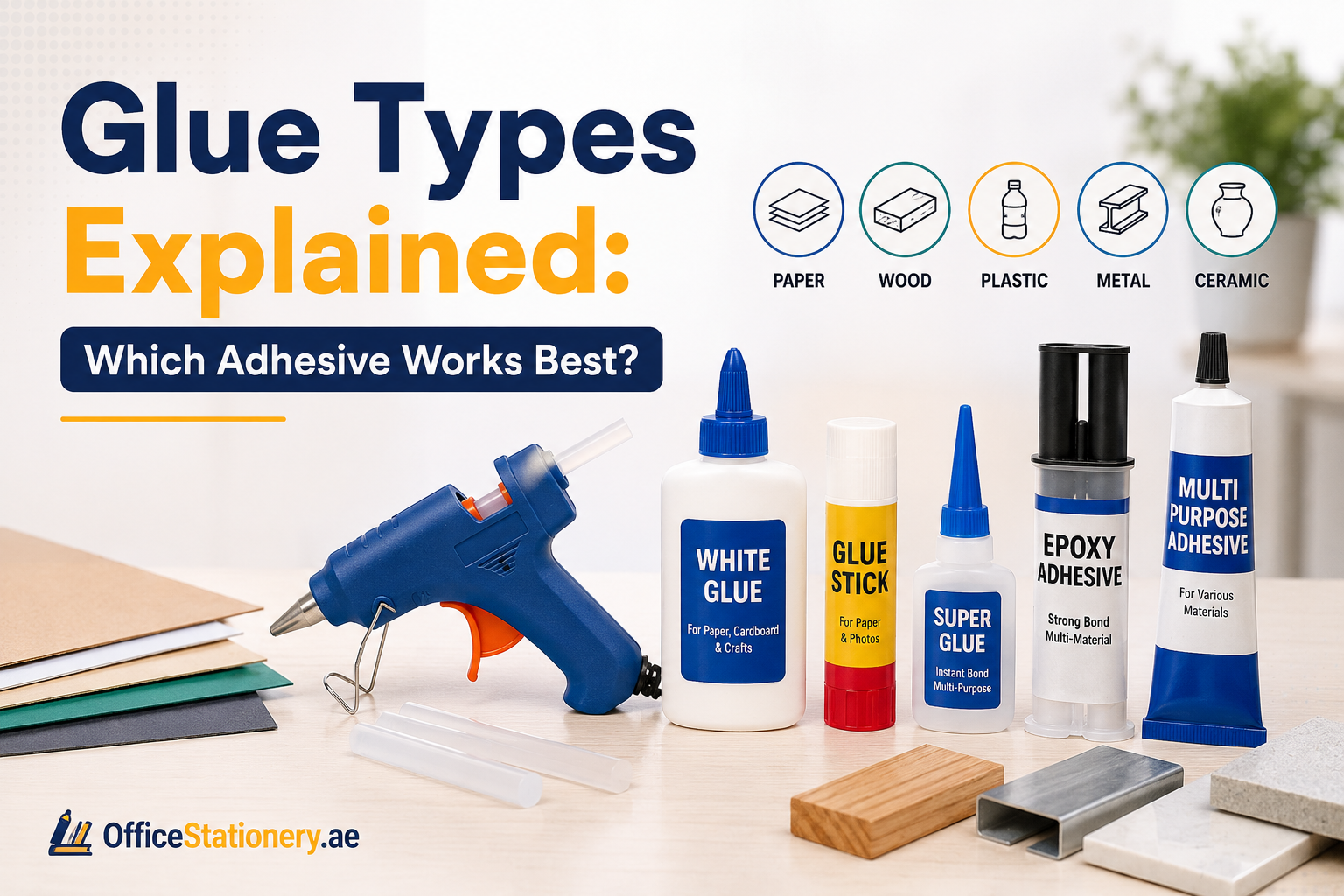
Glue Types Explained: Which Adhesive Works Best?
Introduction (Why Glues Matter)
Whether you're mounting a picture frame, laminating a countertop, or assembling a high-performance drone, the adhesive you choose determines how long the bond-and sometimes the project itself-will last. A great formula can unite dissimilar materials, survive harsh weather, or cure in seconds. A poor choice can fail at the worst moment. This deep-dive explains every major glue category, breaks down the science in plain language, and highlights leading brands and their best-known products so you can pick the perfect adhesive every time.
1. How Adhesives Work (Quick Science in Simple Words)
| Bonding Mechanism | How It Works in One Sentence | Typical Glue Families |
|---|---|---|
| Mechanical interlock | Glue seeps into microscopic pores and locks in as it hardens. | Wood glues, PVA, polyurethane, hot melt |
| Chemical attraction | Molecules on each surface form new chemical bonds with the adhesive. | Epoxies, cyanoacrylates (CA), construction adhesives |
| Evaporation/pressure tack | Solvent or water evaporates, leaving a sticky film that presses parts together. | Contact cement, spray adhesives |
2. Water-Based Adhesives
2.1. PVA (Polyvinyl Acetate) Wood Glue
Best for: Wood-to-wood joints, paper crafts, porous materials
Why it works: Water soaks into fibers; the PVA polymer stays, creating a flexible matrix.
Cure time: Tack in 10-20 min; full strength in 24 h
Top Brands & Flagship Products
| Brand | Popular Model | Key Selling Point |
|---|---|---|
| Titebond | Titebond III Ultimate Wood Glue | Waterproof (ANSI/HPVA Type I), FDA-approved for indirect food contact |
| Elmer's | Elmer's Carpenter's Wood Glue Max | Sandable, paintable, low odor |
| Bostik | Bostik Evo-Stik Resin W | Fast grab (5 min), dries clear |
| Fevicol | Fevicol SH | High viscosity, trusted for furniture lamination |
- Pros
- Non-toxic, easy cleanup with water
- Long open time allows precise alignment
- Dries to a flexible film
- Cons
- Weak on plastic or metal
- Loses strength above 70 °C
- Swells raw MDF if over-applied
3. Reactive (Instant-Bond) Adhesives
3.1. Cyanoacrylate (CA) "Super Glue"
Best for: Small repairs, plastics, rubber, metal, skin closures
Why it works: Reacts with trace moisture on surfaces, polymerizes in seconds.
Cure time: Fixture in 5-60 sec; full strength in 24 h
Top Brands & Flagship Products
| Brand | Popular Model | Notable Feature |
|---|---|---|
| Loctite | Ultra Gel Control | Rubber-reinforced for impact resistance |
| Gorilla | Gorilla Super Glue Gel | Thick gel resists run-off on vertical surfaces |
| Starbond | EM-02 Medium CA | Penetrates hairline cracks; hobby favorite |
| 3M | Instant Adhesive PR-40 | Industrial, high-temperature resistance |
- Pros
- Fast fixing speeds up production
- Bonds many plastics without primer
- Clear, invisible joints
- Cons
- Brittle under shear shock
- Short shelf life once opened
- Fumes can bloom (white frost) on surrounding surfaces
Pro Tip: Store opened CA bottles in an airtight jar with silica gel to double their life.
13. Frequently Asked Questions
- Can I use super glue on wood?
- Yes, but only for small, non-structural joints. Wood fibers absorb CA, reducing bond area. For furniture, choose PVA or polyurethane.
- What glue should I pick for ceramic repair that will see hot coffee?
- A high-temperature epoxy rated to at least 120 °C-e.g., J-B Weld HighHeat-provides thermal shock resistance.
- Is Gorilla Glue really stronger than epoxy?
- Not in ultimate tensile strength. Epoxies routinely exceed 4,000 psi, while polyurethane foaming glues are closer to 3,000 psi but offer gap-filling and water resistance.
- Why did my hot-melt joint fail in the summer?
- Thermoplastics soften near 70 °C-the inside of a parked car can reach that, weakening the bond.
- Can I accelerate epoxy curing?
- Mild warmth (35-45 °C) speeds reaction, but excessive heat can cause exotherm cracks. Use a controlled heat mat.
- Are spray adhesives archival-safe for photographs?
- Only acid-free formulas like 3M Photo Mount or Scotch ATG Gold meet ISO 18916 permanence standards.
- What's the difference between MS-polymer and traditional silicone sealant?
- MS-polymer adhesives cure to tougher, paintable joints and bond better to plastics, whereas silicones stay rubbery and can't be painted.
- How do I remove cured super glue from metal?
- Soak in acetone, scrape gently with a plastic blade, then polish with 1,000-grit paper.
- Can I use wood glue on end grain joints?
- Yes, but pre-seal end grain with diluted PVA first to prevent "glue starvation."
- Do glues expire if unopened?
- Most factory-sealed bottles last 2 years from manufacture. Always check the batch code for the exact "use-by" date.
Conclusion
No single adhesive is "best" for every job. The champion depends on substrate, environment, load, and workflow. Cyanoacrylate shines for tiny, rigid parts; epoxy dominates structural, multi-material builds; PVA remains king of woodworking; and modern hybrid construction glues bridge gaps-literally and figuratively-between traditional chemistries. Armed with the knowledge above, plus a quick test on scrap pieces, you can pick the perfect glue that will hold fast long after the project is done.
Keep this guide bookmarked the next time you wander the adhesive aisle. Choosing wisely means stronger bonds, safer assemblies, and fewer midnight repair sessions hunting for "whatever glue is in the junk drawer."
About the Author